
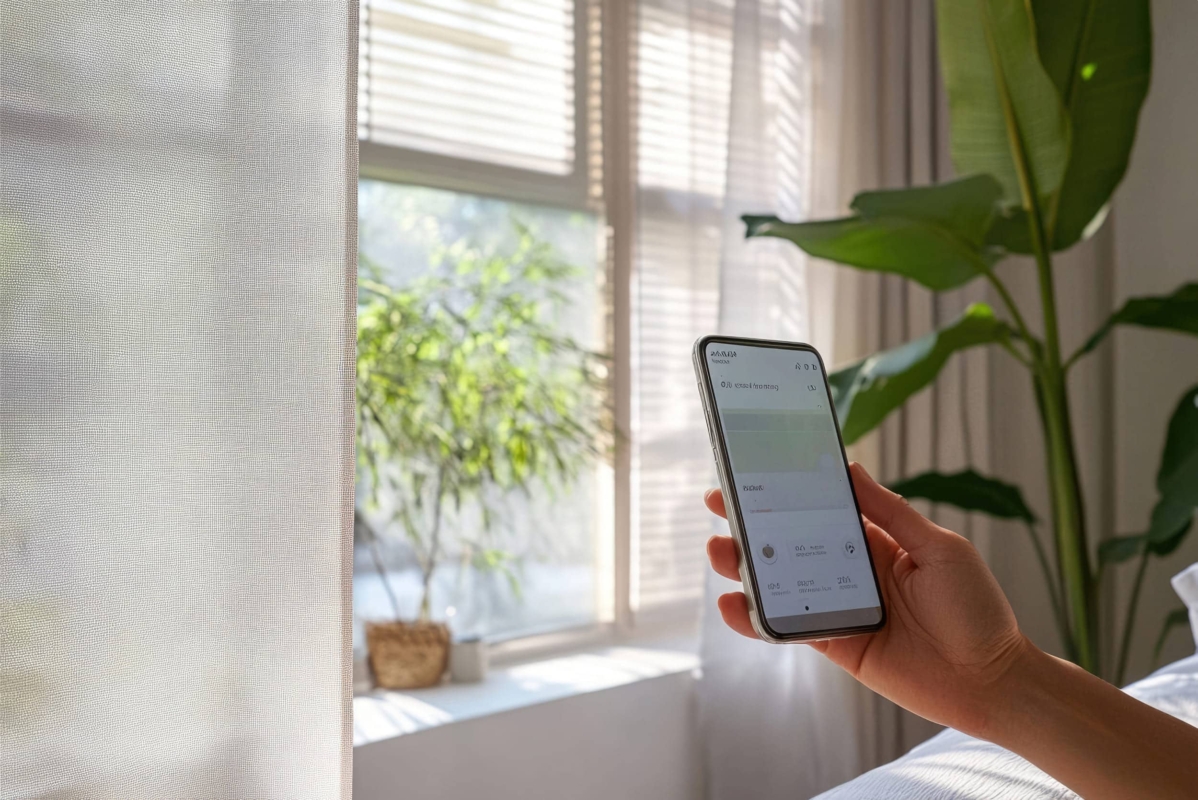
Motorized blinds have moved from luxury novelty to practical upgrade for homeowners across Chicagoland. They give you control over light, privacy, and energy use without lifting a finger, whether you’re dealing with harsh winter drafts in Downers Grove or glare bouncing off Lake Michigan. If you’re curious what’s possible for your home, explore our motorization options and see how these systems fit into a smart home setup.
What Are Motorized Window Treatments and How Do They Work
Motorized window treatments use small electric motors built into the shade or blind headrail, letting you raise, lower, or tilt them through a remote, a smartphone app, or a simple voice command. Power comes from battery packs, hardwired connections, or solar chargers, and each option suits different window types and budgets. Many motorized shades and blinds also include timers or light sensors, so they respond automatically as the day changes instead of waiting for you to remember.
Why Chicagoland Homeowners Are Upgrading to Motorized Shades and Blinds
Demand for motorized window treatments Chicago homeowners can actually live with has grown steadily across the Western, Southwest, and Northwest Suburbs, along with the North Shore and the downtown high-rises. Homeowners want lower energy bills and less furniture fading, and honestly, a lot of them are just tired of wrestling with windows that are a pain to reach by hand.
Energy Efficiency Through Chicago’s Seasonal Extremes
Chicago asks a lot of a window, averaging 25°F in January and 75°F in July. The Department of Energy estimates windows account for 30% to 40% of a home’s winter heat loss, and that tightly installed cellular shades cut that loss by 40% or more, worth about 10% on your heating bill. The catch is that DOE also reports 75% of window coverings never move all day, so most homes never see those savings. Automation is what closes the gap.
UV Protection and Furniture Preservation
Sunlight does more damage to your interiors than most people realize, and UV is the largest single cause of fading. Ordinary window glass filters far less of it than people assume, so a meaningful amount still reaches your floors and furnishings. Solar shades close that gap, blocking anywhere from 90% to 97% of UV depending on how tightly the fabric is woven. Scheduling them to close during peak sun hours protects floors, art, and furniture without giving up daylight the rest of the day.
Convenience, Privacy, and Security
Beyond comfort, motorized shades let you manage privacy and security from anywhere. Scheduling shades to open and close on a set pattern can simulate occupancy, a simple but effective deterrent when you’re traveling or working late.
Cordless operation is also a meaningful safety upgrade for households with young children, since accessible window covering cords are a recognized strangulation hazard and motorized treatments remove them entirely. Pet owners get the same benefit from eliminating dangling cords.
Solutions for Hard-to-Reach Windows in High-Rises and Suburban Homes
Skylights, transoms, and oversized picture windows are notoriously difficult to reach with a wand or cord. Tension-mounted fabric systems are built specifically for skylights and angled windows, holding the fabric flat against gravity rather than letting it sag. Separately, battery-powered and solar-rechargeable motor lines remove the need for wiring in spots where running an electrician’s line isn’t practical. Which of the two fits depends on the window, and it’s one of the things we sort out during the in-home visit. That holds true in a Streeterville high-rise just as much as in a two-story Naperville colonial.
High-rise units bring their own constraints. Floor-to-ceiling glass on a west-facing unit takes hours of hard afternoon sun off the lake, concrete construction limits where anything can be anchored, and most buildings require management approval before work starts and set rules about what the window looks like from outside. We work through all three regularly, and it’s worth raising early rather than after the fabric is ordered.
Types of Motorized Shades, Blinds, and Automated Drapery
Motorization now applies to nearly every window covering category, so choosing the right custom motorized blinds starts with matching the product type to the room’s function.
Motorized Roller and Solar Shades
Roller shades have clean lines, simple operation, and strong performance for light control, which is why they’re the go-to choice for most rooms. Solar shades, a roller variation with specialized fabric, are among the best motorized roller shades for sunny exposures because they cut glare and heat while preserving your view outside.
Motorized Cellular, Roman, and Blackout Shades
Cellular shades trap air in a honeycomb structure, making them one of the more energy-efficient motorized shade options for windows in cold climates. Roman shades bring a softer, fabric-forward look, while motorized blackout shades handle bedrooms, nurseries, and media rooms where total light control matters.
Motorized Wood and Faux Wood Blinds
Motorized wood blinds for windows combine a traditional look with the ease of remote operation. Faux wood versions hold up well in humid or high-sun rooms, giving you durability alongside the classic aesthetic.
Automated Drapery and Curtain Systems
For a more formal or layered look, automated drapery tracks handle heavy fabric panels with ease. The Lutron Sivoia QS Drapery system, for example, offers three drive options supporting draperies up to 175 lbs, with splicing available for longer tracks and curved track solutions for bay and corner windows. Lutron rates the drive unit at no more than 38 dBA measured three feet away, quiet enough for bedrooms and living rooms alike. On the pull-to-start configuration, a manual override lets you open the drapery by hand if power goes out.
Comparing Motorized Treatment Types at a Glance
Each type earns its place in different rooms, and the trade-off usually comes down to insulation versus light quality.
| Treatment Type | Best For | Insulation | Chicagoland Note |
|---|---|---|---|
| Roller and solar shades | Sunny and lake-facing rooms | Low to moderate | Solar fabric cuts glare without giving up the view |
| Cellular shades | Cold-weather performance | Highest | DOE rates these the most insulating interior option |
| Roman and blackout shades | Bedrooms, nurseries, media rooms | Moderate to high | Blackout lining handles early summer sunrises |
| Wood and faux wood blinds | Traditional interiors | Moderate | Faux wood holds up in humid or high-sun rooms |
| Automated drapery | Formal rooms, floor-to-ceiling glass | Moderate to high | Built for the tall window walls in high-rise units |
Smart Home Integration and Control Options
One of the biggest draws of smart window treatments is how naturally they fit into an existing smart home. Homeowners we work with in the Western Suburbs often already have a thermostat or security system running on Wi-Fi, Z-Wave, or a similar protocol, and motorized shades simply become another connected device on that network.
Compatible Ecosystems: Wi-Fi, Z-Wave, Matter, and Thread
Not every ecosystem behaves the same way, and compatibility details matter more than most homeowners expect. Here’s how four common systems compare:
| System | Voice Assistants | Hub Required | Matter/Thread Support | Key Notes |
|---|---|---|---|---|
| Lutron Caséta | Amazon Alexa, Apple Home, Google Home | Yes (via hub/cloud) | Native hub is not a Matter controller; requires a separate Matter-capable hub | Widely used for smart blind setups via hub bridging |
| Somfy TaHoma | Apple Home (Zigbee 3.0 certified since 2023) | Depends on product line | Zigbee 3.0 certified; legacy RTS motors need a bridge and lack native Matter/Thread | Controls both Zigbee and RTS products |
| Lutron Sivoia QS Drapery | Apple Home, Amazon Alexa, Google Home, Josh.ai via RadioRA 3 | Yes, requires a Lutron control system such as RadioRA 3 | Not confirmed by Lutron | Motorized track system, up to 175 lbs, 30 ft span, under 38 dBA |
App, Voice, and Remote Control Comparison
App control gives you access from anywhere, which is handy for adjusting remote control window treatments while you’re at work or on vacation. Voice control offers hands-free convenience for daily routines, while a physical remote remains the simplest option for quick, no-fuss adjustments. Most households end up using a mix of all three depending on the room and moment.
Schedule a free design session and we’ll walk through what would actually work in your home.
Choosing the Right Motorized Window Treatment for Your Space
The right choice depends on more than aesthetics. Room function, window size, and power access all shape which motorized blinds actually make sense for your specific home.
Matching Style and Motorization to Room Function
Blackout shades suit bedrooms and home theaters, while lighter roller or Roman shades work better in living rooms and kitchens where you want daylight most of the day. In condos and HOA-governed communities, visible hardware restrictions sometimes limit exterior-facing treatments, so it’s worth checking your association’s guidelines before finalizing a style.
Power Options: Battery, Hardwired, and Solar
Hardwired systems offer unlimited power and never need battery swaps, but they require an electrician for installation, particularly in older Chicagoland homes without existing wiring near the window. Battery-operated blinds typically run on standard alkaline D-cell or AA batteries, with general retrofit motors lasting six to twelve months between changes depending on how often they’re cycled. Some hybrid-drive designs are built for considerably longer intervals between changes, though figures vary by manufacturer and are worth asking about directly. Solar-rechargeable motors avoid wiring altogether where an electrician’s line isn’t practical, though placement needs enough sun exposure to stay charged.
Why Professional Installation Matters
Basic battery-powered kits exist for simple setups, but smart blinds installation across a multi-window home, with hardwired systems and full smart hub integration, is a different scope of project. Getting motor selection, mounting, and calibration right the first time protects both performance and your warranty.
Connectivity problems are a good example of why that matters: a shade that drops its signal might be fighting interference from nearby appliances or metal fixtures, sitting too far from a poorly placed hub, or running into a pairing fault. Diagnosing which one takes knowing the system, and it’s the kind of call we handle for clients rather than leaving them to work through it.
The Drapery Connection White-Glove Installation Process
Since 1939, four generations of our family business have installed window treatments across Chicagoland, and we hold Lutron Motorization Expert, Somfy Motorization Certified, MechoSystems Consultant, and Mecho HomeSystems Consultant certifications. Our white-glove process starts with an in-home design visit, continues through custom measurement and product selection, and finishes with a trade-quality installation that accounts for the wall type, the window shape, and any existing smart home devices already in place.
Custom Fit, Calibration, and Smart Hub Setup by Experts
Every window is slightly different, and even small measurement errors can cause binding or uneven operation over time. Our installers calibrate each motor for smooth travel, pair treatments to your existing hub, and test multi-window syncing so your whole room responds together rather than in staggered starts and stops.
Schedule Your Free In-Home Consultation with Drapery Connection
Why Chicagoland Homeowners Choose Us
Automatic blind costs vary based on window size, motor type, control system, and how many windows you’re covering, so we provide personalized quotes rather than flat pricing. A few reasons Chicagoland homeowners choose us for custom smart blinds:
- We back our work with a 10-year performance assurance and a 110% price guarantee.
- Our team holds manufacturer certifications across Lutron, Somfy, and MechoSystems platforms.
- We’ve served Chicago-area suburbs, including Downers Grove, since 1939, with both residential and commercial solutions for offices, schools, and restaurants.
Get Started
Contact us or schedule your free in-home consultation today, and we’ll help you find the right motorized window treatments for your home. If you’d rather see the systems running before you decide, our Lincolnshire showroom inside Toms Price Home at 725 Milwaukee Avenue is open Monday through Saturday from 10 to 5 and Sunday from 11 to 5, so you can walk in, operate the motorized samples yourself, and hear how quiet they actually are. Our Downers Grove showroom at 5101 Chase Avenue is open weekdays from 9 to 5 by appointment, which gives you a designer’s full attention for the visit.